
 EN
EN PL
PLI’m not saying I’m a preservationist, but still, I’m from Eastern Central Europe and if there are no potatoes on the table prepared in at least four ways it’s not a big party for me. It is however not such an old tradition, it is said that King Jan III Sobieski was instrumental in bringing the potato to our lands. The ruler, during the relief of Vienna in 1683, sent his beloved Marysieńka a sack of potatoes. Wonderful.
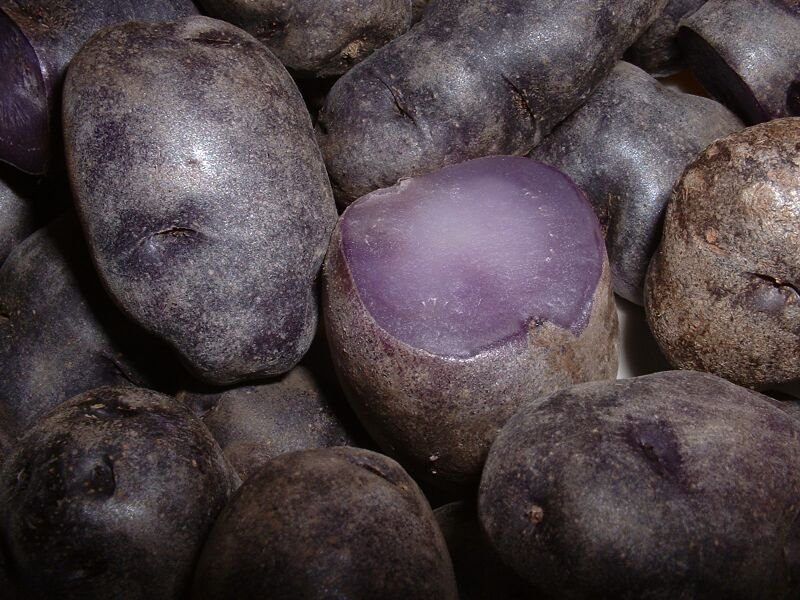
Imagine my enthusiasm when a neighbour presented me with a small sack of lavender seed potatoes (tubers) in the spring. Lavender! I’ll admit that when it came to ‘harvesting’ my potato trophy was quite poor, as I only harvested enough for three dinners. But three lavender dinners in Kashubia is better than zero lavender dinners in Kashubia.
The ”Vitelotte” potatoes only appeared in Poland in the 1980s and are still hardly a popular variety. They have a deep dark blue, almost black skin and faded purple flesh. They are high in the anthocyanins, substances that have anti-inflammatory effects and are very powerful antioxidants that remove excess free radicals from the human body that damage cells.
Unfortunately, Vitelotte, like any potato, has a lot of starch, but after eating it, unlike regular potatoes, the glucose concentration rises more slowly, thanks precisely to the anthocyanins. Therefore, they may be a better choice for diabetics. Our inked potato is also rich in dietary fibre, which reduces the absorption of cholesterol ( yey!).
Ostensibly cooking potatoes is no philosophy, but our first attempt came out…weird. The lavender potatoes were overcooked into a (delicious as it was) mush in 15 minutes. So I recommend cooking them in their uniforms and monitoring the firmness with a fork. And that would be it.
They taste great with a sauce made from boletus or bay boletes, especially those you collect yourself in the Kashubian forests 😉